Passenger count answers one part of an aircraft request. It does not show whether the travelers' luggage can pass through the baggage door, fit the compartment, remain within loading limits, or be reached during the flight. A useful private-jet baggage plan starts with the actual bags and the actual offered aircraft - not a seat number or a category label.
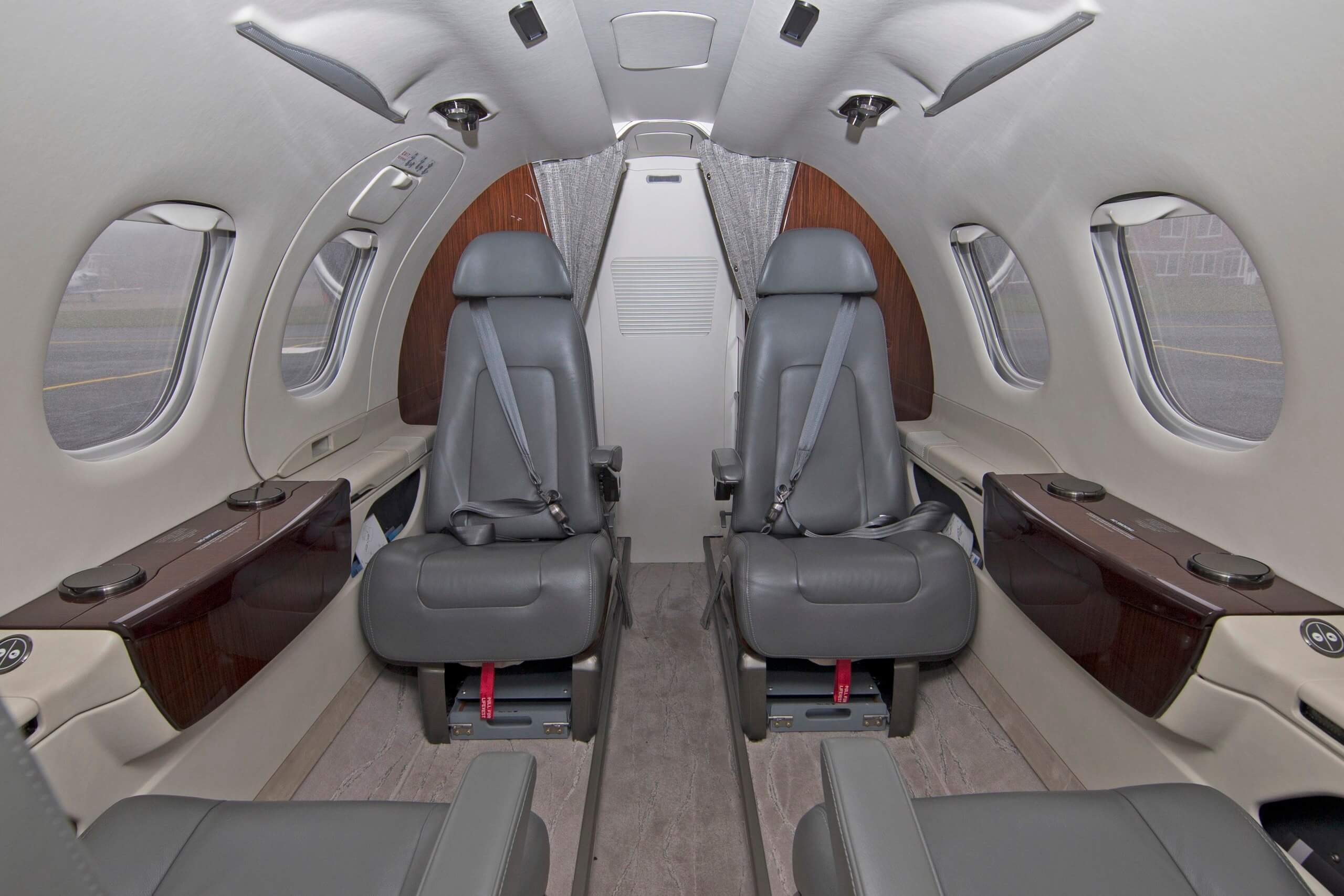
The featured cabin image is an RAF Embraer Phenom 100 reference credited to Cpl Adam Fletcher - RAF/MOD and made available under the Open Government Licence v1 through its Wikimedia Commons source page. It does not depict a current offered tail, prove that a particular bag fits, or imply RAF or MOD endorsement.
Seats do not establish baggage fit
An aircraft may have enough approved passenger seats and still be a poor match for the group's luggage. The relevant review covers the specific tail and cabin layout, the number of people on each leg, every bag, total payload, compartment limits, loading instructions, and the complete itinerary. A different interior configuration can change usable storage even when the model name is unchanged.
Send the bag plan before an aircraft is proposed. The direct air carrier must decide how the aircraft may be loaded and whether the passengers, bags, fuel, route, conditions, and required operating margins work together. A seating chart, category maximum, or marketing capacity cannot replace that trip-specific review.
Volume is not the same as shape
Cubic feet describes volume; it does not prove that a long, rigid, or irregular item can pass through an opening or occupy the available compartment geometry. Record the length, width, and height of each bag in the orientation in which it can safely travel. Identify hard-sided cases, items that cannot be compressed, and anything that must stay upright.
Skis and golf bags deserve individual measurements rather than a label such as "sports equipment." Include the complete packed length and the widest and tallest points, and say whether clubs, skis, poles, shoes, or other pieces are in separate cases. The existing private-jet golf trip guide owns golf-itinerary planning; this guide addresses the baggage brief. Never treat a published cubic-foot total as fit proof without checking door and compartment geometry for the offered aircraft.
Separate total storage from in-flight access
Ask where each item would be stored: in an internal compartment, an external compartment, or another approved location. Then ask which items, if any, can be reached in flight. "Internal," "external," "pressurized," and "accessible" answer different questions; none should be inferred from one total-capacity figure.
For example, Embraer's Praetor 600 brochure publishes 155 cubic feet of total baggage capacity, a standard configuration for 8 passengers, an optional maximum of 12 passengers, and 4,018 nautical miles of range based on 4 passengers and NBAA IFR reserves. The brochure also describes an internal baggage compartment accessible during flight, but the 155-cubic-foot total should not be presented as though all of it is in-flight accessible. Those figures are reference specifications, not a loading approval or a range promise for an offered aircraft. Review the Praetor 600 aircraft page for site planning context.
If medication, work materials, a child's supplies, mobility equipment, or another item may be needed en route, name it in advance. Do not assume the crew can retrieve an item after loading; request written confirmation of its approved location and expected access.
Compare the aircraft actually offered
Use model pages to frame questions, then compare the registration-specific aircraft in the proposal. A brochure or provider page may describe one configuration without representing every aircraft that shares the model name.
| Reference aircraft | Published reference | What the proposal still needs to confirm |
|---|---|---|
| Praetor 600 | Embraer publishes 155 ft³ total baggage capacity and 8 standard / 12 maximum passengers. | Exact tail, seating layout, compartment allocation, openings, loading limits, access, and trip payload. |
| Challenger 350 | VistaJet's Challenger 350 page lists 106 ft³ and 8 passengers for its reference aircraft. | Whether the offered Challenger 350 has the same configuration and how the measured bags will be loaded. |
This table is a reference comparison, not Jet Partners inventory, an aircraft offer, or proof of availability. The same method applies when considering a Gulfstream G650 or Global 7500: use the exact proposed aircraft and a written bag plan instead of assuming that a model label settles fit.
A bigger jet is not automatically the answer
More published storage may help, but selecting a larger aircraft by default can ignore the rest of the mission. Compare the complete itinerary, departure and arrival airports, actual aircraft performance review, budget, cabin needs, overnight positioning, schedule, and baggage plan together. An alternative aircraft, different bag selection, or revised airport plan may be more practical - but none is automatic.
Do not use a generic class cutoff to decide that a certain number of bags requires a certain jet category. Likewise, do not infer guaranteed range, runway capability, or hot-and-high performance from a model page. The direct carrier evaluates the actual tail, loading, route, airports, weather, reserves, and current conditions. The charter pricing guide explains cost inputs without publishing a live model price for this baggage decision.
Send a bag-and-load brief with the quote request
Create one list for each flight leg, especially when passengers or bags change during the trip. Include:
- passenger count on that leg;
- number and type of carry-ons, checked bags, garment bags, and personal items;
- length, width, and height of every bag or case;
- skis, golf bags, instruments, mobility equipment, strollers, or other bulky gear;
- items that must remain upright, cannot be compressed, or require special handling;
- items that may need in-flight access, with the reason for access stated plainly;
- departure and arrival airports, plus acceptable alternatives;
- local travel date and requested departure or arrival time.
Photos can help explain an unusual shape, but measurements and written confirmation remain necessary. Do not send passports, medical records, or other sensitive documents merely to start the baggage-fit discussion.
Ask the proposal to identify the aircraft and direct air carrier, state whether the listed items can be accepted, explain the planned storage locations and access, and note any packing or loading condition. Jet Partners acts as a charter services arranger, not a direct air carrier; the properly licensed direct air carrier for an accepted trip operates the flight and retains operational control.
Ready to compare an itinerary and measured bag list? Request one written charter proposal with the passengers, bag types and dimensions, bulky gear, access needs, airports, date, and local time.
Sources and decision FAQs
Primary specification links are included where the figures appear above. They support the bounded reference values, not a fit decision for a particular trip. Source bodies were independently retrieved and reviewed on September 30, 2026; if a publisher later restricts automated access, the visible public links remain the cited review destinations.
Can soft bags solve a private-jet baggage problem? Soft bags may use irregular space more effectively than rigid cases, but they do not guarantee acceptance. Provide their packed dimensions and count, then have the direct carrier confirm the loading plan for the offered aircraft.
Should golf bags or skis be counted as one standard bag? No. Give each packed case's length, width, and height, plus any separate shoe, pole, or equipment bags. The opening and compartment geometry may matter more than the combined volume.
Can passengers reach checked baggage during the flight? Only if the offered aircraft has an approved accessible storage location and the operating plan permits access. Identify essential in-flight items before loading and obtain confirmation rather than relying on a total baggage figure.
When should baggage details be sent for a charter quote? Send counts, types, dimensions, special handling, and access needs with the initial itinerary. Early details allow proposals to be screened before a wrong-size aircraft is treated as the leading option.
Buyer FAQ
Frequently asked questions
Can soft bags solve a private-jet baggage problem?
Soft bags may use irregular space more effectively than rigid cases, but they do not guarantee acceptance. Provide their packed dimensions and count, then have the direct carrier confirm the loading plan for the offered aircraft.
Should golf bags or skis be counted as one standard bag?
No. Give each packed case's length, width, and height, plus any separate shoe, pole, or equipment bags. The opening and compartment geometry may matter more than the combined volume.
Can passengers reach checked baggage during the flight?
Only if the offered aircraft has an approved accessible storage location and the operating plan permits access. Identify essential in-flight items before loading and obtain confirmation rather than relying on a total baggage figure.
When should baggage details be sent for a charter quote?
Send counts, types, dimensions, special handling, and access needs with the initial itinerary. Early details allow proposals to be screened before a wrong-size aircraft is treated as the leading option.

_Squadron).jpg)